


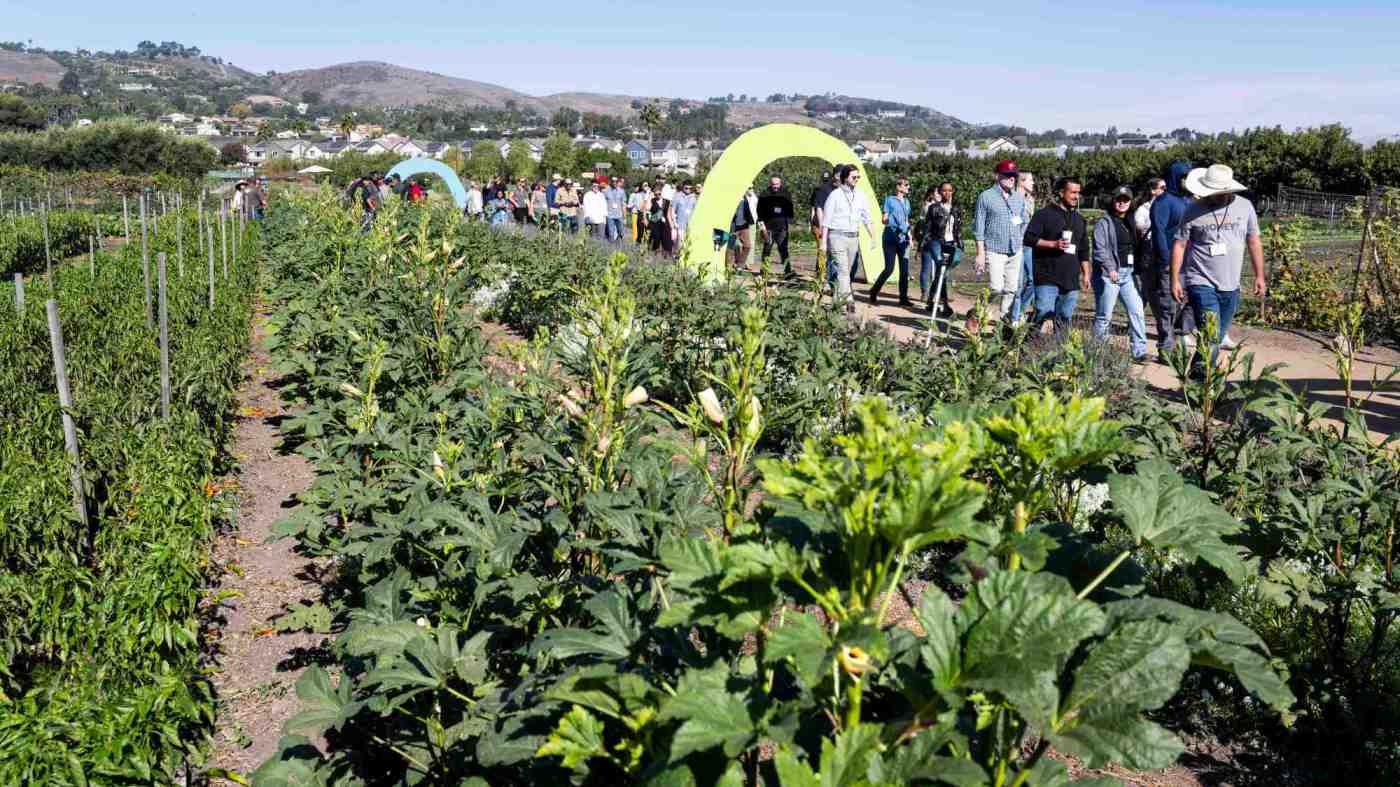
While California’s fertile soils sprout some of the country’s best produce, the transition from pedigree farms to public school cafeterias isn’t always so fruitful.
Enter the Farm-to-School summit at the Ecology Center in San Juan Capistrano, hosted recently by Rumiano Cheese, wherein dozens of California farmers, educators, food service workers and curious citizenry gathered on an early fall afternoon to tour the 28-acre parcel, enjoy meals grown from nearby soil and talk about how to get more organic produce from regenerative farm on school menus.
Key to accomplishing this seemingly herculean task is the integration of local farms with K-12 school systems, said Joe Baird, chief executive officer of Rumiano Cheese and former Ecology Center board member. He emphasizes the need for alternative transportation channels in order to bypass large distributors that have a had a stranglehold on how — and what — kids at public schools eat come lunchtime.


While noting that cost remains a major factor, he says, “funding is available to really tilt toward more local sourcing” care of the U. S. Department of Agriculture, among other agencies. “There’s a pull happening from the districts themselves, and then on the other side there’s support really through both philanthropy and as well as federal support on the demand side, so helping farmers learn how to grow and do this.”
While giving plaudits to the Ecology Center — noted for its regenerative-farm fruits and vegetables that go to area schools, restaurants and average shoppers — Baird also credits other California farms like Dickinson Family Farms in Fallbrook and North Coast Growers in Humboldt, to name a few, that act as distributors to schools throughout the state.
Baird added that “the transportation link is super important” between schools and farms, with central distribution hubs being a main player in the game. “You know that the system is dominated by a few large players and distributors, so it’s very difficult for a small producer to be able to deal with that,” he said at the Oct. 24 summit, adding that creating alternative channels into California districts could help bolster organic fare at schools.
EVOLVING TASTES
Back in the day — the 1980s, for example — a typical lunch menu at any given California public school would consist of processed, preservative-laden sodium bombs like chicken nuggets, alleged spaghetti and meatballs, and, of course, pizza. The state’s then-idea of pizza consisted of a stodgy sheet of bread, a smear of something resembling tomato sauce and flavor-free cheese all of which was baked to a beige hue of legally-edible perfection.
Such lunchtime fare might no longer be the norm.
Jennifer Sherman, culinary director of the Alice Waters Foundation (a nonprofit that, in part, works with the state‘s public schools to improve food procurement) and a former Chez Panisse chef, said that she’s helping lead the charge to build a better pizza. She points to Rumiano, which the USDA awarded a grant to bring cheese into K-12 public schools. The company purchased a shredder to create a custom shreds using organic, regenerative cheese from small family farms.


“They are able to scale where they can service districts, and it’s been enormously successful,” said Sherman. “And they’ve been able to do it at a price point that works, because it’s a direct purchase.”
Districts, she said, are also working with Berkeley-based Acme Bread to create a healthier and tastier crust. “The trick with school food is nutritional compliance, so the grains have to be 51% whole grain,” she explained. Sherman says that in order to keep that fluffy texture that kids prefer, Acme is demoing a pizza crust that is 51% whole grain but uses a white wheat “so that it doesn’t look or taste like that burly whole wheat thing,” she said. “It’s fluffy and it feels like a pizza crust.”
As for the tomato sauce, she’s has it covered: During the summer months, when tomatoes are at their peak and most abundant, her foundation works with schools to gather those tomatoes to process them into the pizza sauce, freezing it into flat bags for the year so that schools don’t have to buy mass-produced sauce, she said.
Kristin Hilleman, director of food and nutrition services at Capistrano Unified School District, echoes Sherman’s sentiments about the progress schools have made in recent years. While most public schools lack central kitchens to prepare from-scratch meals, which in turn means that they rely on packaged fare from distribution centers, they have made headway by sourcing locally grown fare for area cafeterias.


“We have produce from farms that are less than 150 miles from our district,” she said. “That is so cool to me, to have this be available.”
And although menus still have bangers bearing names that bring a smile to many a child’s face (e.g., crispy chicken drumsticks and waffles, chicken double dogs, mozzarella crunchers and make-your-own nachos), her district along with many others have started to tip the scales in favor of organic produce.
“We have been able to bring in more fresh, organic, local produce now than ever before,” she said. “We participated in a cohort with Friends of the Earth that opened us up to a lot of different vendors’ food hubs that wanted to work with the school district.” Working with Dickson Farms, JAS Family Farms and Rumiano, to name a few, her district has been able to hone in on one organic fruit and one organic vegetable each month.
“We brought in tomatoes, Persian cucumbers, other fun veggies, magenta dragon fruit, fuyu persimmons, apple guava, cherimoya, different varieties of citrus” due to the relationships her department has fostered with local farms,” she said.
PUBLIC INVOLVEMENT
And this is only the beginning.
For parents and guardians who want to see more of their kids’ public schools feature the bounty of fruits and vegetables from local, regenerative farms, communication is key.
When asked what the average citizen could do to help such efforts, Sherman said, “Talk to your school board. Write a letter to them. Write a letter to the principal. Say, ‘Hey, I would really like my kid to eat lunch at school, but she won’t because she thinks it’s not very good, or there’s not enough fresh fruit’ or whatever the thing is. Talk to the PTA, go to the PTA meetings and say, ‘Hey, can we talk about getting bulk organic milk in for the kids?’”


Reintroducing kitchens back into schools, Sherman pointed out, is also crucial. “In the ‘80s, we got rid of all the kitchens. Ronald Reagan said that we’re going to centralize food production, and these big food companies are going to make ready-to-eat, shelf-stable, high sugar, high salt food,” she said. “And that’s not real food.”
She also recommends reading “A School Lunch Revolution,” an upcoming book by Chez Panisse founder and food activist Alice Waters, which delves into how we can create nutritious, organic school lunches while staying within the USDA guidelines.
Still, most public schools are saturated with meals that wouldn’t pass muster at most farm-to-table eateries.
The biggest obstacle, according to Hilleman, is finding more farms and more vendors. She said that in her district’s initial process to find them resulted in only one vendor. But most recently, after working with Shared Plate Strategies, a privately held company that works with school nutrition leads, the search proved far more fruitful. Her team sent out request-for-proposals for produce and ended up with 10 vendors bidding. “We awarded nine out of ten,” she said. “This was huge.”
Her efforts have resulted in closer relations with area farmers to help plan for a better culinary future for public schools. “We have some farms and food hubs that deliver just to our central kitchen and we redistribute the produce out,” she said. “It spread the wealth from large distributors to small farmers and everyone in between.”
Another bonus for getting locally-grown produce into public schools? Keeping the Golden State’s once-abundant small farms thriving.
“Small family farms have been in decline for a while. Now the conversation is how will we keep them alive and growing,” said Evan Marks, founder of the Ecology Center, humbly adding, “We’re building community. Asian communities have been doing this for centuries. We’re doing nothing new.”