


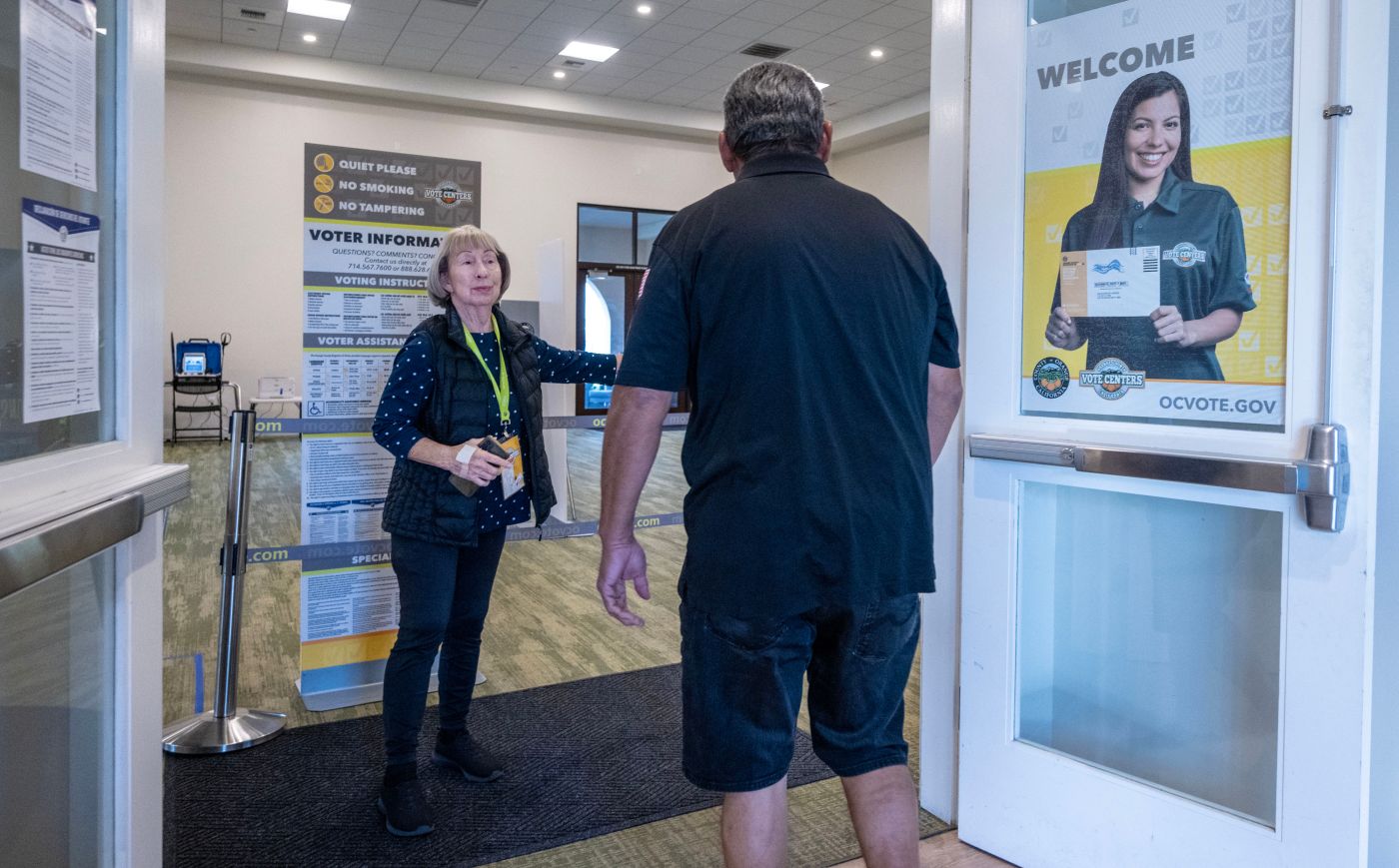
The “Vote Center Handbook,” a guide used by the Orange County Registrar of Voters to train election workers and operate the county’s 184 vote centers, runs 235 pages, give or take a few glossary terms.
In it, the army of more than 1,400 temporary workers who are paid north of $22 per hour to help U.S. citizens in Orange County cast ballots can read up on the intricately detailed rules about where to place equipment when they set up vote centers. Or they can get information about how to properly operate the full range of Verity brand voting machines currently favored by the county. Or they can learn how to handle a Spoiled (damaged, not rotten) Ballot.
Attentive “Handbook” readers can check the specific duties required of the different jobs (Greeter, Line Monitor, Check-in Attendant, Vote Attendant, Scan Attendant and Lead) performed at most vote centers. And they can learn the differences among the three keys (Green, Yellow and Red) required to set up and operate each Verity device.
“Handbook” readers even can find guidance on the best ways to live up to the customer service side of what is, at its core, a customer service job.
“Display confidence when serving the voter,” begins one such tip on page 22.
“This displays confidence in the system.”
What the “Handbook” doesn’t cover – at least not directly – is fear.
As the most contentious election in modern American history draws to a close, and as some voters are already casting ballots and hundreds of thousands more wait to cast or drop off ballots on Election Day, the local men and women working to make sure those ballots are processed legally are getting more training, more back-up support, and more money than ever before.
They’re also facing more pushback.
“It’s not most people, and it’s not every day, but you have people who clearly don’t like this (voting) process, and they let that be known,” said one election worker who, like others interviewed for this story, didn’t want his name to be used for fear of public reprisal.
The role of working an election – something once viewed as a volunteer gig favored by civic-minded retirees – is, in 2024, high-profile, high-stress and, sometimes, highly confrontational.
“It’s a whole new job compared to what it used to be,” the election worker said.
Heightened tensions
Election workers around the country are under siege, facing mounting threats of violence and online harassment.
Those threats, increasingly, are translating into action.
Last year, envelopes containing suspicious powders were sent to registrars of voters offices in Los Angeles and Sacramento, and in at least 16 other states. And in at least some of those envelopes, the powder included fentanyl, a drug that, if ingested, can be fatal in tiny doses.
Last month, the federal Elections Threats Task Force offered updates on 20 other recent cases of election-related violence over the past two years. The results ranged from a sentence of 18 months of home detention for a Florida man who threatened election workers to a 40-month prison sentence for a Texas man who, following the 2020 election, suggested a “mass shooting of poll workers” and threatened to kill the children of a specific election official in Maricopa County, Arizona.
In the sentencing hearing for the Texas man, the targeted worker offered a victim’s statement that addressed the broader result of what happens when election workers are threatened.
“It creates an atmosphere of fear and apprehension. If those who step forward to serve their community – typically an older demographic – are concerned about intimidation or threats, it could discourage them from participating in future election cycles,” said Stephen Richer, a Republican who first was elected Maricopa County recorder in 2020.
“This potential chilling effect not only threatens the robust functioning of our electoral processes, but it also strikes at the heart of our democracy itself,” he added.
The Task Force, a division of the U.S. Dept. of Justice, has established a national tip line specifically to handle threats to election workers.
But all of those moves to stave off or prosecute violence against election workers hasn’t done much to slow an unprecedented exodus among the highest levels of election workers statewide. Since 2020, no fewer than 20 of California’s 58 counties have hired new registrars of voters as outgoing officials have chosen to leave for reasons ranging from retirement to health concerns to stress.
Orange County’s Registrar of Voters, Bob Page, was hired in 2022. He replaced long-time Registrar Neal Kelley, who said his departure, for unspecified reasons, was planned prior to the 2020 election cycle.
Soon after he stopped working for the county, Kelley told Electionline Weekly that while the growing threat of violence wasn’t a cause for his retirement it does pose a problem for people running elections.
“This is a frightening time. And while I remain optimistic, the reality is that a small subset of vocal individuals across the country, with extremist election fraud views, are continually afforded outsized respect. As a result, upcoming elections are not very appealing to those that run them. In fact, this has mutated into a real migraine for election officials.”
The push against election workers in Orange County is less intense than what’s been seen in many parts of the country.
The Orange County District Attorney’s Office – which assigns a team of prosecutors and investigators specifically to cases involving election crime – has investigated some threats, which election officials would not detail. Also, some local election workers said last week that in previous elections they were confronted by a few angry voters and observers.
And Page noted that this year he’s pushed to have members of the Orange County Sheriff’s Department at the Registrar offices during ballot counts and in the agency’s election command center, which handles calls from vote centers around the county.
Also, anybody going into the room where ballots are counted has to pass a metal detector and have any bags searched. And police or deputies follow election workers as they drive with ballots from vote centers to vote collection sites.
“Keeping voters and our staff safe during the election is a top priority,” Page said in an email.
For election workers in the field, threats of violence remain a distant issue.
“Most people – and by most I mean almost everyone – are super nice,” said one election worker at the Los Olivos Community Center.
“That’s why I still do this job,” she added. “It’s still fun to help most people.”
Still, many who worked elections prior to 2020 say the job has darkened.
Gone are the days when voting was a routine expression of democracy. In its place, they describe a world of high anxiety, with voters and workers carrying out the business of electing public officials while wondering what might come from people who promise violence if frustrated by the election’s results.
“I’m probably a lot more wary than I used to be,” said a worker at another vote center in Irvine.
“I won’t say I’m afraid,” she added. “I think ‘afraid’ is what some people want to hear. They want people to quit because they don’t like elections, and they hope fear will make that happen.”
Wide open to all
Elections officials hope that the fix to such wariness, or fear, is simple:
Transparency.
Last week, in the wake of ballot box fires in Oregon, Washington and Arizona, Orange County Registrar Page offered a public media tour of the Santa Ana buildings where votes are dropped off and counted.
He told reporters and some elected officials about how, at the end of nearly every voting day, two-person teams of election workers collect printed votes from vote centers and ballot drop boxes. He described how those teams then take photos of those sealed vote bags, to ensure that protocols have been followed, and then drive in separate, GPS-equipped vehicles to drop off those votes at the Santa Ana office or drop points throughout the county. He talked about how those teams don’t use the same routes from night to night. He talked about how, inside the vote processing center, cameras are trained on the hands of everybody who counts a vote or touches a ballot. He talked about how ballot boxes are bolted to concrete. He talked about fire suppression equipment. He talked about combating disinformation.
What he didn’t mention – but could have – was the rigorous training that election workers undertake at the agency’s Santa Ana headquarters.
After they apply to work any election and pass a background check – but before they’re sent to a vote center – newly hired election workers in Orange County undergo a full day of in-person training, plus several hours of online work. The goal? To become a qualified customer service representative for the Orange County Registrar of Voters.
Last month, during a class in Santa Ana, 11 new hires received a full buffet of election-centric information. They learned how to physically set up and take down vote centers. They learned how to greet voters at a vote center door and usher them to a check-in station. They were taught, and practiced, how to check voter IDs, cross-check those IDs against existing registered voter scrolls, and how to present qualified voters with pristine ballots. They learned how to make sure each voter gets to a nearby voting booth without incident.
They learned how to turn their back to any voter filling out a ballot (no peeking). They learned how to process each completed ballot through an electronic scanning device that, as it scans, creates a paper version of each vote that winds up in a flame-proof safe just beneath each scanning machine.
They also learned what the law says about carrying a firearm into a vote center. (You can’t, in California, though it is legal in several states.) They learned the difference between voter observation (totally legal) and voter intimidation (totally illegal). They learned how to use measuring equipment to create a zone that extends exactly 100 feet from the front door of the vote center, a zone in which “electioneering” – which is, essentially, talking up any candidate or cause, or displaying any sign or clothing or tattoo that favors any candidate or cause – is forbidden.
“This is my safe space,” an election worker said, a few days later, while walking through the no-electioneering zone outside the Los Olivos vote center in Irvine.
She noted, wryly, that supporters of a local congressional candidate had placed campaign signs precisely 2 feet beyond the 100-foot markers at the north and south sides of her vote center’s front door.
“I guess that space,” she said, nodding at the signs, one of which had been defiled, “isn’t so safe.”
The election worker curriculum – and the “Handbook” on how to run vote centers – both offer a lot of information about “de-escalation.” In this context, it refers to the art of defusing tension when vote observers, voters or would-be agitators make statements or threats aimed at disrupting the voting process.
The problem is common enough that the election worker training sessions include pre-written scripts, in which trainees act as “de-escalators” while teachers take on the roles of the aggrieved.
In one script, written to illustrate how to handle allegations of voter fraud, part of the scene goes like this:
“(Customer Service Rep.): “… No, the (voting machines) cannot be hacked because the voting machines and scanners are not connected to the internet and no votes are cast over the internet. That is why everyone votes on paper.”
Voter: “If you believe that then you’re an idiot.”
Later, after the election worker calms the wary voter, the script shifts tone, but only slightly.
CSR: “… Would you like the phone number for the Registrar of Voters? They can give you a much more detailed answer about processing your ballot.”
Voter: (Grumbling) “OK, fine, yes, give me the phone number and my ballot. I still don’t trust any of this.”
Related topics include “corruption of the voting process” and “voter intimidation.”
But other parts of the training – indeed, most of it – is aimed at helping customer service reps meet the needs of most voters. And, it turns out, most voters aren’t so different than, say, customers at Disneyland or Taco Bell.
In a section of the “Handbook” titled “Expectations for Customer Service Representatives,” the county details the “six pillars” of customer service: attitude, interest, action, verbal language, body language and tone of voice.
“It’s not just what you say, but how you say it.”
For election workers, that part of the training still remains a bigger deal than all the talk about violence or frustration.
“It’s a ‘yes’ job,” said one election worker. “People come to you and ask if they can vote. And, assuming they qualify, the answer is ‘yes.’
“What other job lets you say ‘yes’ so much?”


