


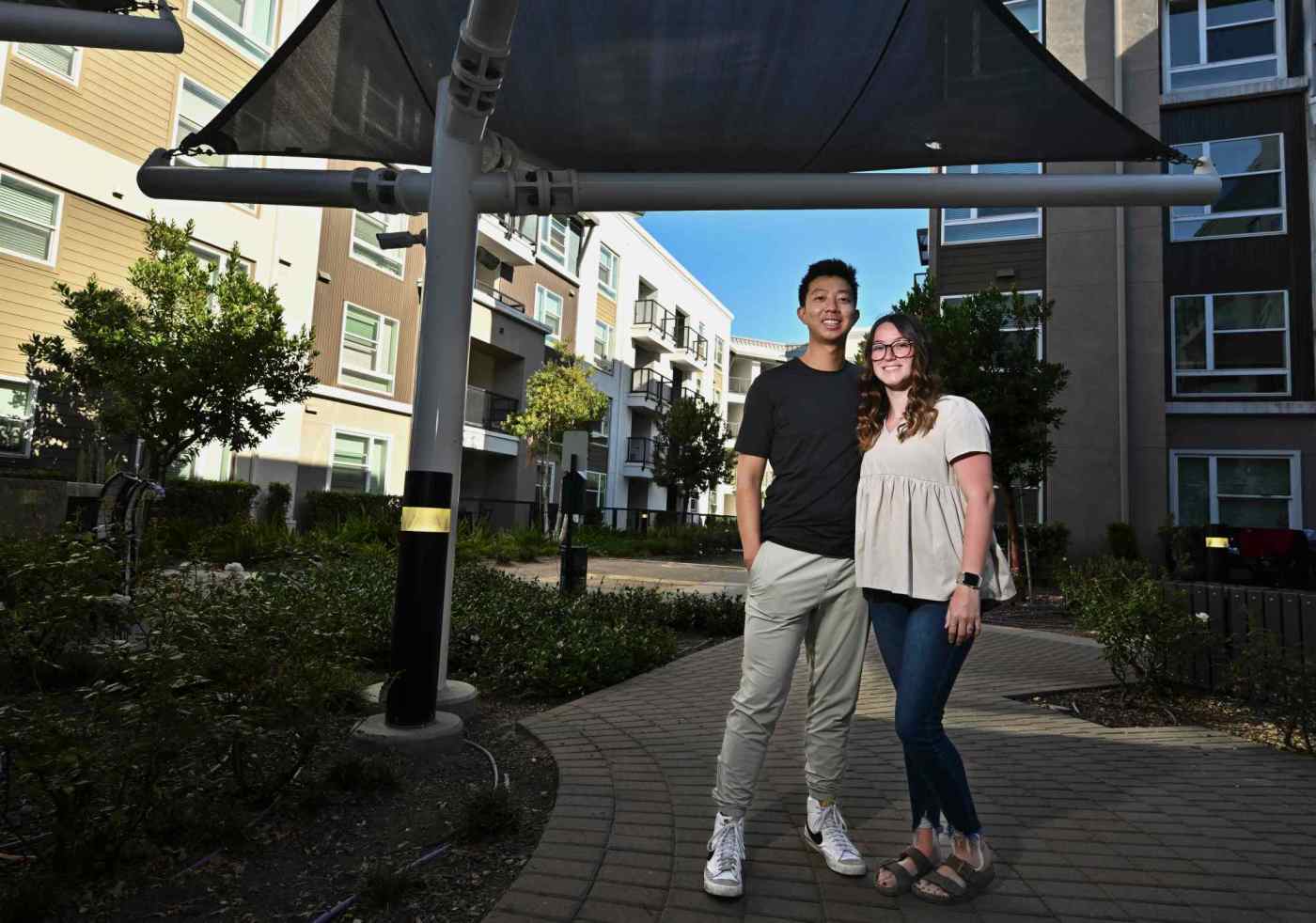
In the sweltering summer heat, Nathan Luong and his girlfriend, Madison O’Rourke, keep the air conditioning off in their Anaheim apartment to save money — and they consider themselves lucky.
Luong and O’Rourke, both 23, live in a one-bedroom unit close to Angel Stadium, Disneyland and the Honda Center, an upscale area known as the Platinum Triangle. The market rate at their complex, the Paramount Platinum Triangle, is $2,854 a month for a similar-size apartment.
But they pay $2,121 under a “workforce” housing program designed to provide reduced rents to people who earn too much to qualify for low-income subsidies but not enough to pay market rates — the so called “missing middle.”
The couple, who make less than $120,000 a year combined, looked at 10 other properties before they found one they could afford in a nice area that included an in-unit washer/dryer and walk-in closet.
But they might end up losing it.
Assessor could upend program
Luong and O’Rourke are caught in a battle between Orange County Assessor Claude Parrish and Paramount’s project administrator over millions of dollars in taxes. Depending on who wins, the reduced rents could vanish for thousands of tenants struggling to afford living in Orange County.
“That would set us back significantly,” said O’Rourke, who is trying to pay off $45,000 in college loans.
It would take more than keeping the AC off. Luong works as a pharmaceutical rep; O’Rourke just landed an entry-level job with Orange County Social Services Agency.
How it works
At issue is a “workforce” strategy used throughout California since 2019 to provide affordable homes to middle-income workers at a time when housing is scarce. In theory, the plan unites government agencies to create a tax-exempt “joint powers authority,” or JPA. This group works with housing developers — known as project administrators — and municipalities to buy apartment complexes through low-interest, long-term municipal bonds.
The apartments are then rented at lower-than-market rates to workers who earn 60% to 120% of the average median income in the area. When the 30-year bonds are paid, the properties are turned over to the cities.
Here’s the rub: JPAs don’t pay taxes, so cities, schools and other government agencies miss out on revenues from the deal until the properties are refinanced or sold decades later, according to the plan.
Argument for taxation
But Parrish contends developers, or “project administrators,” should be taxed now under California’s possessory interest law. He says the 1939 law requires that administrators pay possessory taxes because they are receiving a private benefit from public property.
Parrish has issued possessory interest bills to 10 workforce complexes in Orange County; five of them — including the Paramount complex — are administered by Newport Beach developer Waterford Property Co. Waterford’s total tax assessment amounts to $22 million for the past three years and about $5 million annually.
Parrish contends Waterford and others are making a substantial amount of money by catering to an economic class that is not recognized for property exemptions. There is no government-recognized “missing middle,” he says.
“You’re either low-income or you’re not,” Parrish said. “The worst thing is they tug on people’s heart strings.”
‘Pocketing lots of money’
Furthermore, he claims developers are engaged in a shell game to subsidize rents.
“They’re giving (some renters) a piddling break and they offset it by raising the rent on other tenants,” Parrish said. “They created this out of thin air and are pocketing lots of money.”
Waterford is suing the county, seeking a court order that would force Parrish to rescind the assessments.
Waterford co-founder Sean Rawson says his company has no possessory interest in the properties. Waterford is not located on any of the properties, doesn’t own the structures and basically is acting as a financial consultant to the projects, which encompass 1,370 apartments in Orange and Anaheim. They are owned by the California Statewide Communities Development Authority, a JPA formed in 1988.
“I’ll concede we’re making money, but where do you get possessory interest? We don’t possess anything,” he said. “There’s no way to pay what he’s coming after. I would just quit.”
Rawson argued Waterford would run a deficit of $3.8 million a year on administering the Orange County properties if it has to pay the taxes.
He says if Parrish’s assessments are allowed to stand, the properties would have to charge market rates, erasing the benefit to middle-class renters.
“He would destroy the rent subsidies and displace all these tenants who could no longer afford to live there,” Rawson said. “He wants to destroy middle-income subsidized housing.”
Waterford administers a good chunk of the 2,500 workforce units in Orange County.
Other assessors watching
The assessor in San Diego County also is charging the tax, while assessors throughout the state are watching Parrish.
Said Rawson, “He’s setting extremely bad precedent for property taxes in our state. … We have a public policy crisis that we need more workforce housing. … At the end of the day, they’re the losers if these projects go sideways.”
Rawson said the projects are worth more to the cities than Parrish is contending.
Figures provided by Waterford contend that over the life of the bonds, Orange County governments are deferring $172 million in property taxes from Waterford projects, but will gain $809 million in saved rent. That doesn’t include the $1.4 billion in projected equity after the properties are turned over to the cities, and taxes are paid.
Related Articles
Huntington Beach crafting charter amendment that would leave housing plans up to voters
Huntington Beach housing development at former Magnolia Tank Farm up for approval again
Homeless Count 2024: Fewer people are living on Los Angeles streets this year
10% of California credit card debt is late, 12th-highest delinquency rate in US
What role will housing affordability play in 2024 election?
“The public benefit on these deals is extraordinary,” Rawson said. “The public benefit far outweighs what we’re making.”
Waterford reports that it made $9 million in onetime brokerage fees when the Orange County properties were acquired and collects $2.2 million a year on supplemental bonds for the projects. Additionally, the firm earns $970,000 a year in asset management fees for the properties.
But Rawson said Waterford also risked $17 million in deposits, bond fees and other charges to purchase the properties.
“We make money, yes, but we also provide public good.”
It will be up to the court to decide whether Luong and O’Rourke can afford to stay, and maybe even use the air conditioning.