


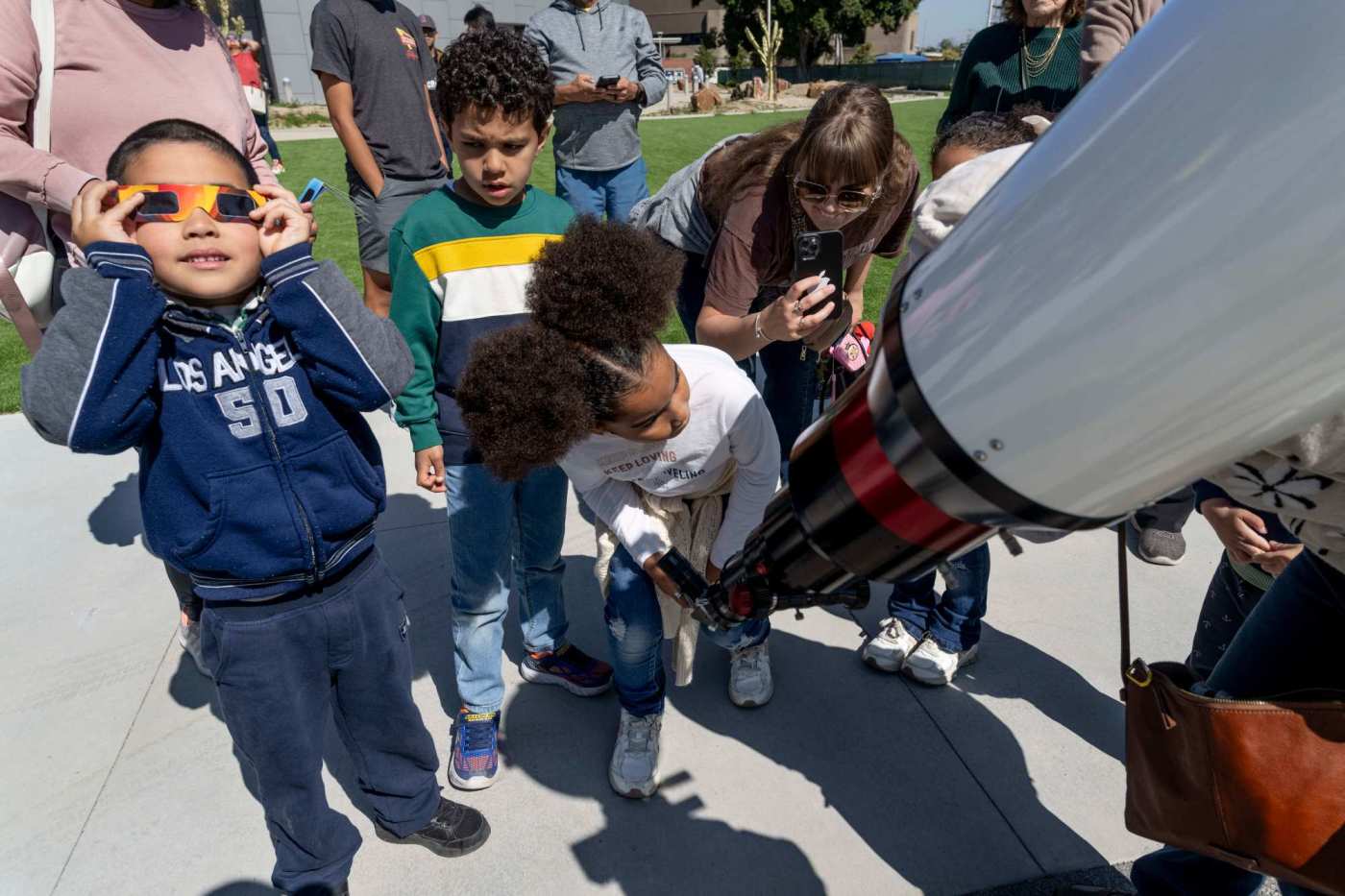
On Monday, April 8, Orange County residents looked up to the sky — with safety glasses, of course — to witness the rare solar eclipse.
Several watch parties were held around the county, including at Orange Coast College in Costa Mesa and Oxford Academy in Cypress, giving people an opportunity to witness the event first-hand.
At the OCC Planetarium in Costa Mesa, astronomy professors and planetarium staff lined the lawn to answer any questions, and the school provided eclipse-safe glasses and brought out solar telescopes for a unique way of viewing. Roughly 3,000 people attended the event, said OCC Planetarium spokesperson Valerie Arriero — much more than the 600 who RSVP’d for it over the weekend.
First-year OCC student Ava Paez traveled up to Oregon with her family to see the 2017 solar eclipse, one that wasn’t as accessible to as many people as Monday’s. But this year, witnessing the eclipse at her school was “incredible,” she said.
“Having the chance to see the eclipse this year at school alongside my classmates was a new and fun way to experience the phenomenon,” Paez said. “It just amazes me how nature works in wondrous ways.”
The eclipse Monday sparked an interest in astronomy for second-year OCC student Emily Bradshaw, who said her professor canceled class so everyone could witness the moon blocking out the sun.
“I am thankful my professor let us skip class to view the event,” Bradshaw said. “I have never seen anything like this before. … It just makes you appreciate the vast expanse of stars and planets in the universe and how they simply just create magical experiences like this for us.”
Even people from outside Orange County came to Costa Mesa to attend the eclipse viewing party. Michele Jarin, who lives in Corona, heard about the viewing party over the weekend and thought it would be a “wonderful idea” to bring her young kids.
“Things like this only happen every so often, and I had to jump on the opportunity,” Jarin said. “Seeing the beauty of this world was well worth the hour-long drive from home.”
Jarin also had the chance to view the 2017 solar eclipse but said having her children join her this time makes the day even more special.
“Traveling to see the 2017 solar eclipse was obviously incredible,” Jaris said, “but to share this day with my kids outweighs that day by a longshot. I hope I can be with them when the next eclipse happens in a couple of decades.”
After the solar spectacle, visitors were invited inside OCC’s Planetarium to watch “Totality,” a planetarium show created by Rice University, explaining the process of a total solar eclipse. OCC Chamber Singers ended the event by performing a “celestial medley” for all visitors to enjoy.
Southern California wasn’t on the path of the total eclipse, but the moon covered about 57% of the sun’s diameter during the peak of totality at around 11:12 a.m.
At Oxford Academy, 1,250 students gathered shoulder-to-shoulder on an open field to observe the eclipse.
Sourish Mehta, 13, was particularly interested in the rare scientific event. The eighth grader, who is interested in physics and wants to be an engineer, said he didn’t remember much about the 2017 eclipse. After all, he was a first grader at the time.
On Monday, wearing solar eclipse glasses, he explained what he saw: “I see part of the moon that overlaps the sun. We are in the penumbra area,” or a partially blocked area.
Related Articles
Solar Eclipse 2024: What the total eclipse looked like across North America
Sun, moon, stars of the show as Solar Eclipse 2024 delights Southern California
Weather’s the hot topic as eclipse spectators stake out their spots in US, Mexico and Canada
Solar Eclipse 2024: What Southern California should know as things go dark(er)
Why are scientists so excited over Monday’s solar eclipse?
Oxford Academy science teacher Clay Elliott was absent on Monday, said Pam Hester, the school’s science program coordinator. Elliott, a “total eclipse chaser” was in Texas, observing from the umbra area, where all light was blocked. He will likely have a PowerPoint presentation to show his classes on his return — he did for the last eclipse, Hester said.
As Mehta played with a colander that reflected a shadow of crescents on white paper, math teacher Randy Douthat explained how the celestial occurrence can relate to math.
“Students can figure out the percentage of the sun that is blocked by the moon,” Douthat said.
The next total solar eclipse won’t be visible from the U.S. until Aug. 22, 2044, but totality will only occur over North Dakota and Montana, plus parts of northern Canada. However, the next total solar eclipse spanning over a majority of the states will occur on August 12, 2045.
Photographer Mindy Schauer contributed to this story.